Does Title Insurance Protect You From an Adverse Possession Claim?
July 19, 2026
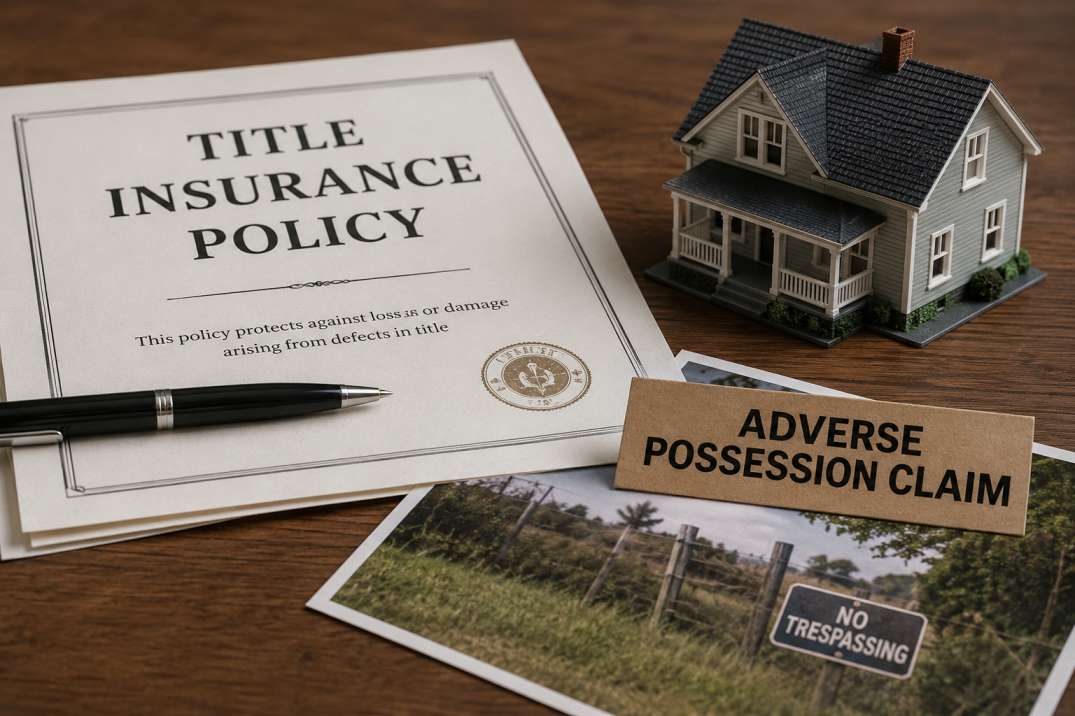
No, probably not. Most title insurance will not help you if someone tries to take your property through adverse possession (the legal process squatters use to eventually claim ownership). That’s because this type of insurance is built to catch problems buried in paperwork, not problems happening in person on your land. There is a special upgraded policy that can help a little, but only if you get it before any squatter shows up.
Why Doesn’t Title Insurance Cover This?
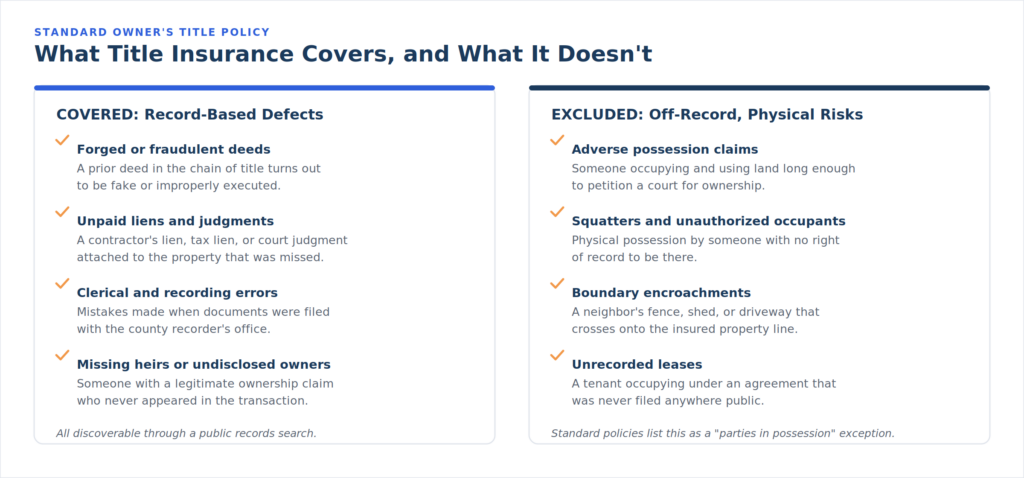
Think of title insurance like a background check on your property’s paperwork trail. When you buy a home, the title company digs through old records to make sure nobody else secretly has a claim to it. Maybe a past owner forged a signature. Maybe there’s an unpaid bill attached to the house that nobody noticed. Maybe someone made a filing mistake at the county office years ago. Title insurance protects you from all of that.
But adverse possession isn’t a paperwork problem. It’s a real-world problem. It happens when someone physically lives on or uses your land for a long time, openly, without your permission, until eventually the law lets them ask a court for ownership. There’s no document sitting in a filing cabinet that would have warned your title company this was coming. Nobody could have looked it up in advance. If you’re not sure whether someone on your property actually counts as a squatter, a trespasser, or a tenant, our Squatting vs Trespassing guide breaks down the difference, since it changes what your insurer, and the law, expects of you.
Because of that, title insurance policies have a specific rule built in that says: “we don’t cover problems caused by someone who is already physically occupying the property.” Insurance people call this the “parties in possession” exception. Courts have backed this up too. A federal court case in late 2025 confirmed that insurance companies don’t have to pay out or defend you in situations like this.
What This Actually Means If It Happens To You
Let’s say you bought a house a few years ago. Now you find out someone has been quietly using part of your backyard, or worse, a court has already sided with them. You call your title insurance company expecting help.
The hard truth: they will most likely say no and point straight to that exclusion.
This surprises a lot of people, because title insurance is sold as protection against “losing your property.” Losing your property to a squatter is exactly that. But it’s one of the very few big risks the standard policy simply doesn’t touch.
Is There Any Kind Of Insurance That Does Cover This?
Sometimes, yes, but only if you plan ahead. Some title insurance companies sell an upgraded version of their policy that removes or shrinks the “parties in possession” exclusion. To get it, you usually need to:
- Pay for a professional survey of the property’s boundaries
- Let someone physically inspect the land for signs that anyone else is using it (fences, sheds, worn paths, that kind of thing)
- Pay a bit more for the policy itself
If everything checks out clean, meaning no signs that anyone else is on the land, the insurance company might agree to cover this risk going forward.
The catch: this only works before there’s a problem. If a squatter is already living on your land when you apply, no insurance company is going to agree to cover a mess that’s already started. It’s a tool for preventing a future problem, not fixing a current one.
So What Actually Protects You?
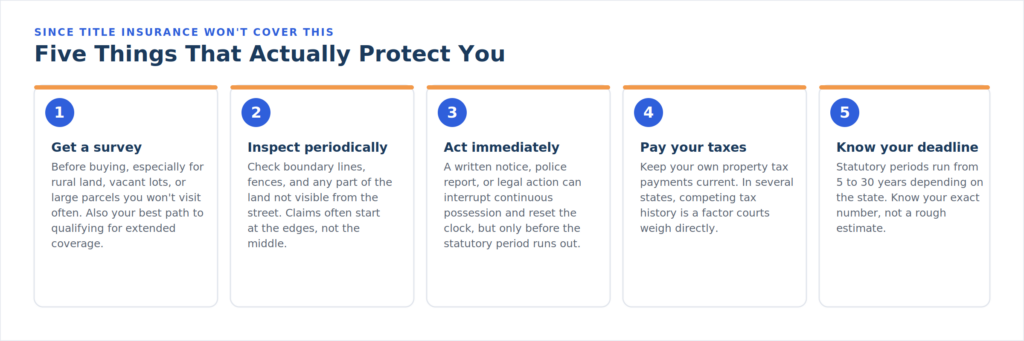
Since insurance mostly won’t save you here, the real protection comes down to things you do yourself:
- Get a survey done before you buy, especially if it’s a large property, vacant land, or somewhere you won’t visit often. This also helps you qualify for that upgraded insurance policy if you want one.
- Check on your property once in a while. Walk the property lines. Look at the parts you can’t see from the street. Most of these situations start quietly on the edges of a property, not in the middle of it.
- Move fast if you spot someone unauthorized on your land. Every state requires the squatter to occupy the land continuously, without a break, for a certain number of years before they can claim it. If you send a written notice, call the police, or take legal action, you can interrupt that clock, but only if you catch it in time. Our Adverse Possession Deadline Calculator can show you exactly how much time is left before that clock runs out.
- Keep paying your own property taxes. In a lot of states, judges actually look at who’s been paying the taxes when deciding these cases. If you’re current and the squatter isn’t, that helps your case.
- Know exactly how long the clock is in your state. This isn’t the same everywhere. Some states only need 5 years, others need up to 30. Run the numbers with our Statutory Period Calculator, or look up your exact state’s rule here.
The Simple Version
Title insurance is great at catching sneaky paperwork problems from the past. It’s not built to stop someone from physically moving onto your land today.
If that’s what worries you, a survey, regular check-ins on the property, and quick action the moment you notice something wrong will protect you a lot more than your insurance policy will. And if you own land you don’t visit often, it’s worth calling your title company directly and asking what an upgraded policy would actually cost you.
If a squatter is already on your property and you’re weighing what removal will actually cost, our Eviction Cost Estimator can give you a realistic estimate of court fees, attorney costs, and timeline before you get started. And if the occupant in question is a family member rather than a stranger, the rules shift in some important ways, our guide on family members becoming squatters covers that specific situation.
Sources: This article is based on guidance from major title insurance companies like First American Title, legal write-ups explaining how adverse possession exclusions work in real policies, and a 2025 federal court ruling (Eastern District of New York) that dealt with this exact issue.
This article is for general information only. It isn’t legal or insurance advice. Every title insurance company writes its policies a little differently, and coverage for things like adverse possession can vary by state and by insurer. Talk to a licensed attorney and your title insurance company before making any decisions based on what you read here.