Can Police Remove Squatters? Only in These 8 States
July 26, 2026
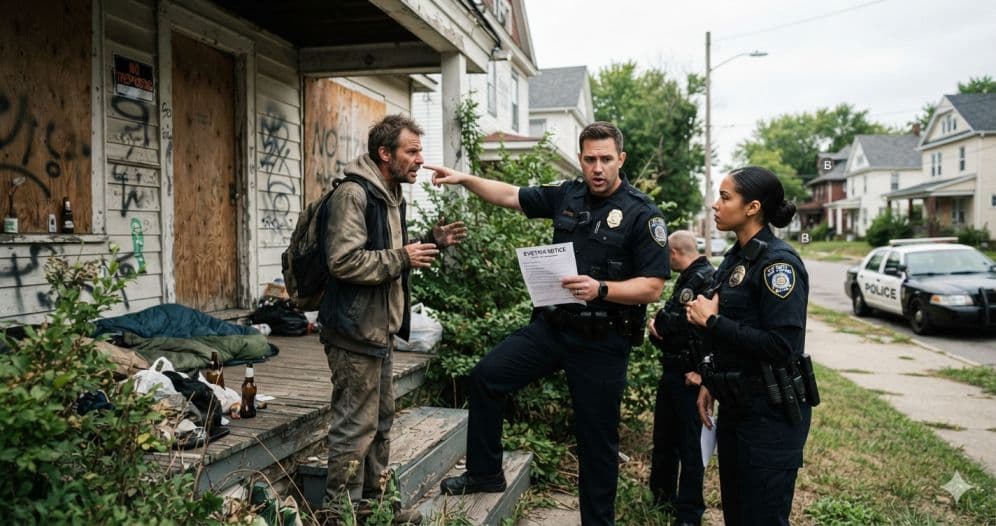
Can You Call the Police on a Squatter? What Actually Happens
Quick answer: Yes, you can always call the police, but in most states they will not remove the person on the spot. Unless the situation meets a narrow set of conditions (a very recent break-in, no claim of a lease, and no ongoing dispute), officers are trained to treat an occupied property as a civil matter, not a crime scene. That leaves the owner to pursue eviction in court, even against someone who was never a tenant. A small but growing number of states have changed this in the last two years, and this guide covers exactly which ones, and what actually determines whether an officer acts.
Why Police Usually Call It a “Civil Matter”
Officers are generally trained to avoid getting involved in disputes over who has the legal right to occupy a property, because that determination is a landlord-tenant or property-law question, not a criminal one. If the person inside claims to have a lease, claims to be a family member of the owner, or has been living there for any meaningful length of time, most departments will decline to remove them and instead tell the owner to “go through the courts.” This is true even when the owner is certain the occupant has no legitimate claim. Officers are wary of misjudging the situation and being held liable for an unlawful eviction themselves.
The Conditions That Make Police Act Immediately
Across the states that do allow faster police action, three facts tend to matter most:
- Recency of entry. A break-in discovered within the last day or two reads as an active crime. A person who has clearly been living there for weeks reads as a possession dispute.
- Evidence of forced entry. Broken locks, a pried door, or a forced window support a criminal trespass response. An unlocked door or a key someone claims to have been “given” does not.
- Absence of any competing claim. No lease, no rent receipts, no prior permission from the owner, and no pending litigation over the property. The moment any of these appear, even a low-quality forged lease, many departments will step back and say it needs to go to court.
Every State, Grouped by How Fast Police Can Actually Act
Squatter law changed more between 2024 and 2026 than in the previous several decades combined. Below is every state grouped into three tiers, based on whether police can act directly or an owner still needs a full civil eviction.
Tier 1: Expedited, Police or Sheriff-Assisted Removal 8 states
These states let an owner bypass the standard eviction timeline by filing a sworn complaint directly with the sheriff or a magistrate, rather than filing suit in ordinary civil court. If the conditions are met, law enforcement can serve a notice to vacate and restore possession within a set window, sometimes as short as 24 hours.
| State | Statute | How it works |
|---|---|---|
| Florida | Fla. Stat. § 82.036 (HB 621, 2024) | Owner files a verified complaint with the sheriff. The sheriff verifies ownership and serves an immediate notice to vacate. |
| Georgia | OCGA § 16-7-21.1 (HB 1017, 2024) | Occupant has 3 business days to produce proof of a lawful right to occupy. Failing that, removal and possible citation follow. |
| Alabama | Ala. Code § 35-9B-2 (Act 2024-237) | Owner submits a sworn affidavit. Law enforcement can remove the occupant without a traditional lawsuit. |
| Tennessee | Public Chapter 1009 (2024) | Owner files a verified complaint with the sheriff. Removal is required within 72 hours of filing. |
| West Virginia | HB 4940 (2024) | Squatting is classified as criminal trespass, removing it from the standard eviction process entirely. |
| South Carolina | 2025 legislation, signed by Gov. McMaster | Owner files a petition with magistrate court. An ex parte removal order can issue immediately, with a hearing to follow within 24 hours. |
| North Carolina | Session Law 2025-88 (effective Dec. 1, 2025) | Owner files an affidavit. The sheriff serves the occupant and a magistrate hearing follows within roughly 48 hours. |
| Texas | SB 1333 (effective Sept. 1, 2025; enforcement provisions apply to filings on or after Jan. 1, 2026) | Gives sheriffs a direct path to remove squatters and criminalizes fraudulent leases, alongside separate eviction-process reforms under SB 38. |
Tier 2: Squatting Criminalized, But Removal Usually Still Goes Through Court 13 states
These states passed laws in 2024 and 2025 that make unauthorized occupation a criminal offense, which matters for prosecution and deterrence, but in most cases physically removing the person still requires the standard eviction or unlawful detainer process unless narrow statutory conditions are met. Treat police involvement in these states as case by case, not guaranteed.
| State | What changed | What it means for a 911 call |
|---|---|---|
| California | Squatting can be charged as criminal trespass | Responding officers decide on the spot whether someone is a trespasser or a squatter. If classified as a squatter, the owner still has to win an unlawful detainer suit before the sheriff can remove them. |
| Nevada | Criminalized squatting (2024) | Gives prosecutors a charge to bring, but removal generally still runs through the standard eviction process. |
| Washington | Criminalized squatting (2024) | Same pattern as Nevada: a criminal charge exists, but a formal unlawful detainer action is still typically required to physically remove the occupant. |
| Arkansas | 2025 legislation criminalizing unauthorized occupation | New enough that consistent police practice is still developing. Expect to be directed toward eviction court unless the entry was clearly forced and very recent. |
| Idaho | 2025 legislation criminalizing unauthorized occupation | Same caveat as Arkansas: recent law, uneven enforcement so far. |
| Indiana | 2025 legislation criminalizing unauthorized occupation | Same caveat: confirm current local practice with your county sheriff before relying on a fast response. |
| Kentucky | 2025 legislation (HB 142) making squatting a felony and authorizing arrest | Gives police clearer authority to arrest, but a possession order to retake the property may still require a court filing. |
| Maryland | 2025 legislation criminalizing unauthorized occupation | Recent law. Expect standard eviction process to still apply in most cases. |
| Mississippi | 2025 legislation criminalizing unauthorized occupation | Recent law. Confirm current enforcement practice locally. |
| Montana | 2025 legislation criminalizing unauthorized occupation | Recent law. Standard eviction process is the safer assumption for now. |
| North Dakota | 2025 legislation criminalizing unauthorized occupation | Recent law. Confirm current enforcement practice locally. |
| Utah | 2025 legislation criminalizing unauthorized occupation | Recent law. Standard eviction process is the safer assumption for now. |
| Wyoming | 2025 legislation criminalizing unauthorized occupation | Recent law. Confirm current enforcement practice locally. |
Tier 3: Standard Civil Eviction Required, No Expedited Statute 30 states + DC
In these states there is no expedited statute at all. An unauthorized occupant who claims any kind of tenancy, however flimsy, generally has to be removed through the same eviction process used for a nonpaying tenant: notice, filing, hearing, judgment, then a sheriff-executed writ of possession.
| State | Removal path |
|---|---|
| Alaska | Standard unlawful detainer / eviction process. |
| Arizona | Standard unlawful detainer / eviction process. |
| Colorado | Standard unlawful detainer / eviction process. |
| Connecticut | Standard summary process eviction. |
| Delaware | Standard eviction process. |
| District of Columbia | Standard eviction process through DC Superior Court. |
| Hawaii | Standard summary possession / eviction process. |
| Illinois | Standard eviction process (forcible entry and detainer). |
| Iowa | Standard eviction process. |
| Kansas | Standard eviction process. |
| Louisiana | Standard eviction process. |
| Maine | Standard forcible entry and detainer process. |
| Massachusetts | Standard summary process eviction. |
| Michigan | Standard eviction process. |
| Minnesota | Standard eviction process. |
| Missouri | Standard eviction process. |
| Nebraska | Standard eviction process. |
| New Hampshire | Standard eviction process. |
| New Jersey | Standard eviction process. |
| New Mexico | Standard eviction process. |
| New York | Standard eviction through housing court. Worth calling out: the 2025 state budget clarified that a squatter who trespasses is not automatically entitled to tenant-like protections after 30 days, closing a loophole that previously slowed removals in New York City. The change affects how a case is argued in court, not whether police remove someone directly. |
| Ohio | Standard eviction process (forcible entry and detainer). |
| Oklahoma | Standard eviction process. |
| Oregon | Standard eviction process. |
| Pennsylvania | Standard eviction process. |
| Rhode Island | Standard eviction process. |
| South Dakota | Standard eviction process. |
| Vermont | Standard eviction process. |
| Virginia | Standard unlawful detainer process. |
| Wisconsin | Standard eviction process. |
What To Do Before You Call the Police
- Document everything first. Photos of forced entry, dates you last had lawful access, and any communication with the occupant.
- Have proof of ownership ready. A deed, title, or mortgage statement. Officers responding to these calls will almost always ask for it on the spot.
- Do not change the locks, shut off utilities, or remove belongings yourself first. This is called self-help eviction, and it is illegal in every state, including the ones with fast-track squatter laws. Doing it can expose the owner to liability even when the occupant had no legal right to be there at all.
- Know which tier your state falls into from the tables above, so you know what to actually ask for when you call.
What Happens After You Call
In a Tier 1 state, expect the responding officer to ask for your ownership documents and then either direct you to file the sworn complaint or take an initial report while you prepare it. In a Tier 2 or Tier 3 state, expect the officer to take a report, possibly ask the occupant a few questions, and then tell you this needs to go through eviction court, even if you are confident the person broke in a week ago. That response can feel like a non-answer, but it is the standard, liability-driven posture almost everywhere without a specific statute saying otherwise.
Common Mistakes That Make This Worse
- Assuming ownership alone is enough. It almost never is, on its own, without also addressing recency of entry and the absence of a competing claim.
- Waiting too long to call. The longer someone occupies a property, the more it looks like a possession dispute rather than a break-in, even in Tier 1 states.
- Confronting the occupant directly before involving police or an attorney. This can escalate quickly and, in some cases, exposes the owner to trespass or assault allegations of their own.
- Assuming your state is Tier 1 when it is not. These laws are new and unevenly adopted. Always confirm your specific state’s current statute before acting.
Frequently Asked Questions
Will police remove a squatter the same day I call?
Only in the Tier 1 states listed above, and only if the occupant cannot produce any documentation suggesting a lawful right to be there. Everywhere else, expect to be directed to civil court.
What if the squatter shows a lease when police arrive?
Even a lease that looks forged is usually enough to make police step back and call it a civil dispute. Fraudulent leases are increasingly being criminalized separately (Florida and Alabama both added specific penalties for this), but proving fraud still typically happens in court, not on the doorstep.
Is it faster to just change the locks myself?
No, and it can backfire on you legally. Self-help eviction is illegal in every state, and an occupant who is locked out can potentially sue for wrongful eviction, sometimes for statutory damages on top of actual costs.
Does it matter if the property is vacant land versus an occupied home?
Yes. Several of these statutes, including Florida’s, are written specifically for residential dwellings, not vacant land or commercial property, which may fall under different rules entirely.
Next Steps
If you are not sure whether the person on your property legally qualifies as a squatter, a holdover tenant, or something in between, start with our Squatter or Tenant Status Checker. It walks through exactly the facts police and courts look at. If eviction is the likely path in your state, our Eviction Cost Estimator and Cash for Keys Offer Calculator can help you plan the cost and timeline, or explore a faster voluntary alternative.
This article provides general legal information current as of mid-2026 and is not a substitute for advice from a licensed attorney in your state. Squatter-removal laws are changing quickly. Confirm current statutes with a local landlord-tenant attorney or your county sheriff’s office before acting.
Sources
- Florida Statute § 82.036, The Florida Senate, official statute text
- Georgia HB 1017 (Squatter Reform Act), LegiScan bill history and text
- Alabama HB 182 / Act 2024-237, LegiScan bill history and text
- West Virginia HB 4940, LegiScan bill history and text
- South Carolina 2025 squatter removal law, The Post and Courier
- Texas SB 1333, LegiScan bill analysis
- Tennessee Public Chapter 1009 (HB 1259 / SB 795, 2024) and North Carolina Session Law 2025-88, per state legislative summaries
- New York 2025 state budget provisions on unauthorized occupants, per state legislative summaries