What Happens to a Squatter’s Belongings After Eviction? A State-by-State Guide
July 18, 2026

Property Law · Eviction · Abandoned Property
Bottom line up front: You cannot touch anything yet. In almost every US state a squatter’s belongings left after eviction are still legally protected personal property. Throwing them out, selling them, or keeping them before following your state’s exact rules can send you right back to court facing a lawsuit worth more than the items themselves. This guide tells you exactly what the law requires you to do in each state.
You went through the whole thing. You served notice. You filed in court. You attended the hearing. You got the judgment. The sheriff came out and removed them. And now you are standing in your own property looking at a couch, a broken television, three garbage bags of clothes, and a mattress that someone else left behind.
This is where most property owners make a serious and expensive mistake. The eviction is over but your legal obligations are not. Every state has specific rules about what you must do with belongings left behind after an eviction. Breaking these rules, even accidentally, can result in the former occupant suing you successfully for the value of the items, plus damages in some states.
Here is what you actually need to know.
Why Their Stuff Still Has Legal Protection
This is the first thing most property owners want to understand. If the person was there without any right to be, why do their belongings have any legal protection?
Personal property rights exist separately from the right to occupy real estate. Even after a court has ruled that someone had no right to be in your building, the physical objects they left behind are still legally theirs until those objects are formally abandoned or transferred through the proper legal process.
There is also an important distinction that changes which rules apply to your situation. If the squatter was treated as a tenant during the eviction process, meaning you went through the standard unlawful detainer or eviction court process, landlord-tenant law governs their belongings. If they were removed as a trespasser under newer expedited removal laws in states like Texas, Florida, Tennessee, or Illinois, different rules may technically apply. Those newer removal laws do not always clearly address what to do with belongings afterward. When in doubt, apply the more protective standard and talk to a local attorney before touching anything.
A note on new state laws: Several states passed fast-track squatter removal laws in 2024 and 2025. In those states the removal itself is now faster. But the rules about what you do with belongings left behind were not always updated alongside the new removal laws. If you are in a state that recently changed its squatter laws, check both the new removal statute and the existing abandoned property rules before you act.
The One Rule That Applies in Every Single State
Before getting into the state-by-state breakdown, this point needs to be stated plainly because it is the mistake that costs property owners the most money.
You cannot immediately throw out, sell, keep, or destroy a squatter’s belongings in any US state. Self-help disposal is illegal everywhere. In New Jersey, doing this wrong allows the former occupant to sue you for twice the actual value of the items. In California you can be liable for the full value plus potential additional damages. Even in states with the shortest waiting periods you must follow notice and storage rules before touching anything of personal value.
How the Process Works in Most States
The timelines and notice requirements vary a lot by state, but the general framework is consistent enough that understanding it first makes the state-specific rules much easier to follow.
- Inventory everything before you touch anything. As soon as the eviction is complete and you have possession back, document every item left behind. Photograph or video the whole place before moving anything. Write a detailed list and date it. This protects you if the former occupant later claims you threw away things that were not actually there.
- Separate garbage from personal property. Most states let you immediately throw out food, clear garbage, and obvious debris. Furniture, clothing, electronics, documents, and anything with apparent personal value must be handled by your state’s rules.
- Send written notice to the former occupant. Most states require you to send written notice to the person’s last known address telling them their belongings are being held and giving them a deadline to claim them. Some states require the notice to describe the items specifically enough that the person can identify what belongs to them.
- Store the items for the required period. You must keep the items somewhere safe and accessible for the period your state requires. You can leave them on the property, move them to another location, or use a storage facility. Some states allow you to charge storage fees.
- Dispose of items after the waiting period. Once the required time has passed without anyone claiming the belongings, you can typically sell, donate, or discard them. Some states require you to return any sale proceeds minus your storage costs to the former occupant.
State-by-State Breakdown: What You Must Do
The table below contains verified information based on current state statutes as of 2026. Every statute link goes directly to the official legal source. Always verify with a local attorney before taking action, especially in states that passed new eviction laws recently.
| State | Hold Period | Notice Required | Key Rule | Official Statute |
|---|---|---|---|---|
| Alabama | 14 days | Yes, written | May store on or off premises. May recover costs from sale proceeds. | Ala. Code § 35-9A-423 |
| Alaska | 15 days | Yes, written | May sell items after notice period and deduct storage costs from proceeds. | Alaska Stat. § 34.03.260 |
| Arizona | 5 days after writ | Yes, written | One of the shortest periods in the country. Act promptly but follow notice requirements first. | Ariz. Rev. Stat. § 33-1370 |
| Arkansas | Not specified | Yes | Reasonable time standard. Use 30 days as your safe default. | Ark. Code § 18-16-108 |
| California | 18 days | Yes, must describe each item in detail | Items over $700 must go to public auction. Items under $700 may be donated or disposed of. Strict liability for skipping steps. | Cal. Civ. Code §§ 1980-1991 |
| Colorado | 15 days | Yes, written | May sell unclaimed items after notice period and keep proceeds after deducting costs. | Colo. Rev. Stat. § 38-20-116 |
| Connecticut | 15 days | Yes, written | Must store in a secure location. May charge reasonable storage fees. | Conn. Gen. Stat. § 47a-11b |
| Delaware | 7 days | Yes, written | Short period. Document everything and send notice the day the eviction is completed. | Del. Code tit. 25, § 5715 |
| Florida | 10 days after notice | Yes, written required before any disposal | May move items outside the property line. No duty to store or protect after notice. Items may be sold or discarded after the period. | Fla. Stat. § 715.104 |
| Georgia | No specific period | Not required by statute | Minimal statutory protection. Reasonable care still recommended to avoid liability. | O.C.G.A. § 44-7-55 |
| Hawaii | 15 days | Yes, must describe each item in detail | Notice must describe items specifically enough for the person to identify what belongs to them. | Haw. Rev. Stat. § 521-56 |
| Idaho | 3 days after written demand | Yes, written | Very short period. Items may be sold or disposed of 3 days after written demand is sent. | Idaho Code § 6-316 |
| Illinois | 7 days | Yes, written stating intent to dispose | The 2026 squatter removal law changed how squatters are removed. The 7-day abandonment rule for belongings stayed the same. | 765 Ill. Comp. Stat. 710/1 |
| Indiana | 90 days | Yes, written | The longest holding period in the country. You cannot dispose of anything until 90 full days have passed from when notice was sent. | Ind. Code § 32-31-4-2 |
| Iowa | 14 days | Yes, written | Items may be donated, sold, or discarded after the period. Landlord may keep proceeds after deducting storage costs. | Iowa Code § 562A.25 |
| Kansas | 30 days | Yes, notice must be published in a local newspaper | The only state requiring newspaper publication of notice rather than mailing it directly to the former occupant. | Kan. Stat. Ann. § 58-2565 |
| Kentucky | 14 days | Yes, written | May sell or discard items after the notice period. May recover storage costs from proceeds. | Ky. Rev. Stat. Ann. § 383.665 |
| Louisiana | Not specified | Reasonable notice | Louisiana is a civil law state with different property law principles than the rest of the US. Consult a local attorney before taking any action. | La. Civ. Code art. 3418 |
| Maine | 7 days | Yes, written | Short period. Send notice and document everything on the day the eviction is completed. | Me. Rev. Stat. tit. 14, § 6013 |
| Maryland | No specific period | Not specified by statute | Limited statutory guidance. Courts apply a reasonableness standard. Talk to an attorney before disposing of anything. | Md. Code, Real Prop. § 8-401 |
| Massachusetts | No specific period | Yes, must describe items in detail | Notice must describe items. A reasonable storage period applies. 30 days is the safe standard here. | Mass. Gen. Laws ch. 239, § 4 |
| Michigan | 7 days | Yes, written | May store items off-premises and charge storage fees. Items may be sold after 7 days. | Mich. Comp. Laws § 554.602 |
| Minnesota | 28 days | Yes, written | Must store items in a secure, accessible location for the full 28 days. | Minn. Stat. § 504B.271 |
| Mississippi | 30 days | Yes, written | Standard 30-day period. Items may be sold after the period expires. | Miss. Code Ann. § 89-8-13 |
| Missouri | No specific period | Not specified by statute | Limited statutory guidance. Good faith efforts to notify and reasonable time apply. Use 30 days as your safe standard. | Mo. Rev. Stat. § 441.065 |
| Montana | 15 days | Yes, written | May sell items after the notice period and recover storage costs from proceeds. | Mont. Code Ann. § 70-24-430 |
| Nebraska | 7 days | Yes, must describe items in detail | Notice must describe items with enough detail for the person to identify them. Short 7-day period so act immediately. | Neb. Rev. Stat. § 76-1444 |
| Nevada | 30 days | Yes, written | Standard 30-day period. May charge reasonable storage fees and deduct from sale proceeds. | Nev. Rev. Stat. § 118A.460 |
| New Hampshire | 7 days | Yes, written | Short period. Send notice and document everything on the day of the eviction. | N.H. Rev. Stat. Ann. § 540-A:3 |
| New Jersey | 30 days | Yes, written | One of the strictest states. Improper disposal allows the former occupant to sue for twice the actual value of the items. Follow every step exactly. | N.J. Stat. Ann. § 2A:18-72 |
| New Mexico | 5 days after notice | Yes, written | Short period but notice is mandatory before any disposal. Send notice on the day the eviction is completed. | N.M. Stat. Ann. § 47-8-34.1 |
| New York | 30 days | Yes, written required before any auction | Must store items for 30 days. After that may auction unclaimed items. Some municipalities have stricter rules than the state minimum. | N.Y. Real Prop. Law § 235-e |
| North Carolina | 7 days after writ | Yes, written | The 2025 expedited removal law changed how squatters are removed. Standard abandonment rules still apply to belongings left behind. | N.C. Gen. Stat. § 42-36.2 |
| North Dakota | 28 days | Yes, written | May recover storage costs from sale proceeds. Standard rules apply. | N.D. Cent. Code § 47-16-30.1 |
| Ohio | 30 days | Yes, written | Must store items and provide written notice of the storage location to the former occupant. | Ohio Rev. Code Ann. § 5321.16 |
| Oklahoma | 15 days | Yes, written | Standard rules apply. Items may be sold or discarded after the notice period expires. | Okla. Stat. tit. 41, § 130 |
| Oregon | 15 days after written notice | Yes, written | May charge reasonable storage fees. Items may be sold after the notice period. | Or. Rev. Stat. § 90.425 |
| Pennsylvania | 10 days | Yes, written | Items may be disposed of after the 10-day notice period expires. Document the disposal method. | 68 Pa. Stat. § 250.505a |
| Rhode Island | Reasonable time | Yes, written | No specific number of days specified. Use 30 days as your safe standard. | R.I. Gen. Laws § 34-18-38 |
| South Carolina | 10 days after notice | Yes, written | Items may be sold after the period expires. Proceeds minus costs go back to former occupant. | S.C. Code Ann. § 27-40-730 |
| South Dakota | No specific period | Not specified | Limited statutory guidance. Use 30 days and document everything to protect yourself. | S.D. Codified Laws § 43-32-26 |
| Tennessee | 30 days | Yes, written | The 2024 sheriff removal law changed how squatters are removed. The 30-day abandonment rule for belongings stayed the same. | Tenn. Code Ann. § 66-28-405 |
| Texas | 60 days | Yes, written | One of the longer periods. The 2026 SB 38 changed how squatters are removed but the 60-day abandonment rule for belongings did not change. | Tex. Prop. Code § 92.014 |
| Utah | 15 days | Yes, written | May charge storage fees and deduct from sale proceeds before returning the remainder. | Utah Code Ann. § 78B-6-816 |
| Vermont | 60 days | Yes, written | Ties with Texas for the longest holding period. Must store everything safely for the full 60 days before any disposal is permitted. | Vt. Stat. Ann. tit. 9, § 4462 |
| Virginia | 24 hours to 10 days depending on value | Yes, written | Items with apparent value under $5 may be discarded immediately. All other items require written notice and a storage period. | Va. Code Ann. § 55.1-1254 |
| Washington | 45 days | Yes, written | One of the longer periods. Must hold everything for 45 full days after serving written notice. | Wash. Rev. Code § 59.18.310 |
| West Virginia | 30 days | Yes, written | The 2024 criminal trespass law changed squatter removal. The 30-day abandonment rule for belongings stayed the same. | W. Va. Code § 37-6-6 |
| Wisconsin | Not specified | Yes, written | Notice required but no minimum holding period specified. Use 30 days to be safe. | Wis. Stat. § 704.05 |
| Wyoming | Not specified | Not specified | Limited statutory guidance. Reasonable care and reasonable time apply. Talk to a local attorney before disposing of anything. | Wyo. Stat. Ann. § 1-21-1207 |
The States Where You Need to Be Extra Careful
Infographic
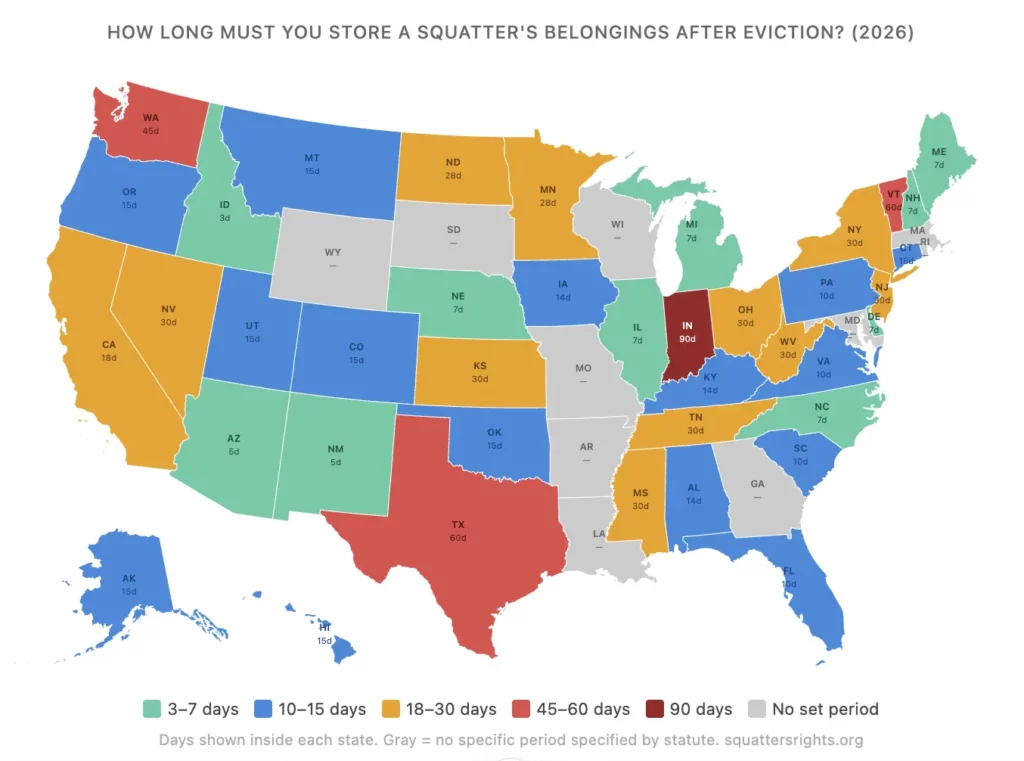
How long must you store a squatter’s belongings after eviction? Days shown per state. Gray = no set period specified by law. © squattersrights.org 2026
New Jersey
New Jersey is the most dangerous state to get this wrong. If you dispose of a former occupant’s belongings without following the proper procedures, they can sue you for twice the actual value of the items. If someone left behind $3,000 worth of furniture and you threw it out without notice, that is potentially a $6,000 judgment against you. Follow the 30-day rule exactly in New Jersey and keep records of every step.
California
California has an 18-day holding period and splits belongings into two categories based on value. Items worth less than $700 can be kept, donated, or disposed of after the notice period. Items worth more than $700 must go through a public sale with advertising, giving the former occupant a chance to claim the proceeds minus your costs. Your written notice must describe each item specifically enough for the person to identify what belongs to them. California courts have issued significant damage awards against property owners who skipped any part of this process. You can read more about how California squatters rights laws work in our full state guide.
Indiana
Indiana gives former occupants 90 days to claim their belongings. That is the longest mandatory holding period in the United States. If you have a former squatter’s belongings in your Indiana property, you are legally required to store everything safely for three full months before you can do anything with it. The clock starts when you provide written notice to the last known address.
Texas and Vermont
Both states require a 60-day holding period. This is worth highlighting specifically for Texas because the state passed significant new squatter laws under SB 38 in 2026 that allow for faster removal of unauthorized occupants. Those laws address the eviction and removal process. Once the person is removed and belongings are left behind, the standard 60-day abandonment rule still applies. The new Texas removal laws did not change what happens to the belongings afterward. For a full breakdown of the new Texas laws, see our Texas squatters rights guide.
Washington
Washington requires 45 days of storage after written notice is served. Washington also has strong tenant protections generally and courts here tend to scrutinize landlord conduct carefully in eviction-related matters. Document everything in Washington.
A Few Situations That Come Up More Than You Would Think
Animals Left Behind
Pets are legally considered personal property in every US state. If a squatter leaves an animal behind, you generally cannot release it or drop it at a shelter without following your state’s notice process. Most states treat pets the same as other abandoned property in terms of notice requirements. If the animal appears to be in distress, call animal control right away. They have authority to remove animals in danger regardless of the abandonment process. If the animal is fine but simply left behind, contact your local animal control agency about the correct procedure before doing anything.
ID Documents and Important Papers
Several states specifically require landlords to keep government-issued identification, financial documents, medical records, and legal papers separate from other belongings and give former occupants the ability to retrieve these documents even after the standard holding period has expired. Even in states without specific rules on this, best practice is to set these items aside and let the person retrieve them separately from other belongings.
Vehicles Left on the Property
Cars and other vehicles left behind are subject to completely different rules in virtually every state. Most states specifically exclude motor vehicles from the abandoned personal property statutes that cover household goods. Vehicles fall under state vehicle codes and usually require you to contact law enforcement or a licensed towing company rather than handling things yourself. Call your local police non-emergency line for guidance before touching any vehicle left on your property.
They Come Back After the Holding Period
If a former occupant contacts you before the holding period expires and asks to retrieve their belongings, you are generally required to let them do so at a reasonable time. You can require them to do this with you or a witness present. You do not have to let them into the property unsupervised. Once the holding period has expired and you have properly disposed of the items according to your state’s rules, a former occupant who shows up afterward has generally lost their claim, provided you followed every required step.
What You Can and Cannot Do Right After the Eviction
You can do these things immediately after regaining possession: Change the locks. Secure all entry points. Remove food, garbage, and obvious debris. Take a complete photo and video inventory of everything remaining. Turn utilities on or off as needed. Make emergency repairs to restore the property to a safe condition.
You cannot do these things until the holding period expires: Throw away furniture, clothing, electronics, or any item of apparent personal value. Sell any belongings. Keep any items for your own use. Donate items to charity without following your state’s proper procedures. Allow anyone else to take items.
The Documentation That Protects You If You Get Sued
The most important thing you can do after a squatter eviction is create a paper trail proving you followed every required step. If the former occupant sues you claiming you improperly disposed of their belongings, your documentation is your defense.
- Take date-stamped photos and video of everything on the day the eviction is completed, before moving or touching anything.
- Write a detailed inventory. Be specific. Not just “clothes” but “approximately 4 garbage bags of clothing, 2 pairs of shoes, one winter coat.” Not just “electronics” but “one flat screen television approximately 40 inches, one black laptop computer.”
- Send written notice by certified mail with return receipt requested to every address you have for the former occupant. Keep the receipt and the green card when it comes back.
- Put the expiration date of the notice period on your calendar. Do not dispose of anything before that date regardless of what was left behind.
- If you store items off-site, document where they are stored, the date they were moved, and include the storage location in your notice so the person can retrieve their belongings.
- If you sell items after the holding period, keep records of what was sold, the price you received, and what happened to the proceeds.
- Keep all records for at least two years after the final disposal. Statutes of limitations for property disputes typically run at least one to two years in most states.
The eviction ends when the court says it does. What you do with the belongings afterward is a completely separate legal obligation that can follow you into a courtroom even after the squatter is long gone.
Understanding the difference between a squatter and a trespasser matters here too, because it determines which removal process was used and in turn which rules apply to the belongings they left behind.